Trang Web Hướng Dương Txđ
|
Trang Web Hướng Dương Txđ |
|
32 Năm Sau, Mỹ Công Nhận đã Phản Bội Việt Nam Cộng Hòa |
Another Vietnam?By MAX BOOT
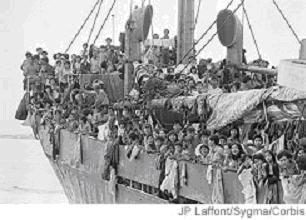
President George W. Bush boldly abandoned that template with his speech to the Veterans of Foreign Wars on Wednesday. In a skillful bit of political jujitsu, he cited Vietnam not as evidence that the Iraq War is unwinnable, but to argue that the costs of giving up the fight would be catastrophic -- just as they were in Southeast Asia. This has met with predictable and angry denunciations from antiwar advocates who argue that the consequences of defeat in Vietnam weren't so grave. After all, isn't Vietnam today an emerging economic power that is cultivating friendly ties with the U.S.? True, but that's 30 years after the fact. In the short-term, the costs of defeat were indeed heavy. More than a million people perished in the killing fields of Cambodia, while in Vietnam, those who worked with American forces were consigned, as Mr. Bush noted, to prison camps "where tens of thousands perished." Many more fled as "boat people," he continued, "many of them going to their graves in the South China Sea." That assessment actually understates the terrible repercussions from the American defeat, whose ripples spread around the world. In the late 1970s, America's enemies seized power in countries from Mozambique to Iran to Nicaragua. American hostages were seized aboard the SS Mayaguez (off Cambodia) and in Tehran. The Red Army invaded Afghanistan. It is impossible to prove the connection with the Vietnam War, but there is little doubt that the enfeeblement of a superpower encouraged our enemies to undertake acts of aggression that they might otherwise have shied away from. Indeed, as Mr. Bush noted, jihadists still gain hope from what Ayman al Zawahiri accurately describes as "the aftermath of the collapse of the American power in Vietnam and how they ran and left their agents." The problem with Mr. Bush's Vietnam analogy is not that it is inaccurate, but that it is incomplete. As he noted, "The tragedy of Vietnam is too large to be contained in one speech." If he chooses to return to the subject in future speeches, there are some other parallels he could invoke: • The danger of prematurely dumping allied leaders. A chorus of voices in Washington, led by Sens. Carl Levin and Hillary Clinton, is calling on Iraqis to replace Prime Minister Nouri al Maliki. Even Mr. Bush and his ambassador to Baghdad, Ryan Crocker, have expressed disappointment with Mr. Maliki. They have been careful, however, to refrain from any calls for his ouster. That's wise, because we know from our experience in Vietnam the dangers of switching allied leaders in wartime. Today we should stick with Mr. Maliki, imperfect as he is. He took office little more than a year ago after his predecessor, Ibraham al Jaffari, was forced out by American pressure for being ineffectual. The fact that we are bemoaning the same shortcomings in both Messrs. Jaffari and Maliki suggests that the problems are not merely personal but institutional. The Iraqi constitution, written at American instigation, gives little power to the prime minister. The understandable desire was to ward off another dictator, but we shouldn't now be complaining that the prime minister isn't able to exercise as much authority as we would like. The only hope for long-term political progress is to limit the power of the militias -- the real powers -- which must start by curbing the violence which gives them much of their raison d'être. That is what the forces under Gen. David Petraeus's command are now doing. We'll need considerably more progress on the security front before we can expect any substantial political progress at the national level. In the meantime, we shouldn't hold Mr. Maliki to unrealistic expectations as we did with Diem. • The danger of winning militarily and losing politically. In 1968, after Gen. Creighton Abrams took over as the senior U.S. military commander in South Vietnam, he began to change the emphasis from the kind of big-unit search-and-destroy tactics that Gen. William Westmoreland had favored, to the sort of population-protection strategy more appropriate for a counterinsurgency. Over the next four years, even as the total number of American combat troops declined, the communists lost ground. Following in Abrams's footsteps, Gen. Petraeus is belatedly pursuing classic counterinsurgency strategies that are paying off. The danger is that American politicians will prematurely pull the plug in Iraq as they did in Vietnam. If they do so, the consequences will be even worse, since Iraq is much more important strategically than Vietnam ever was. • The danger of allowing enemy sanctuaries across the border. This a parallel that Mr. Bush might not be so eager to cite, because in many ways he is repeating the mistakes of Lyndon Johnson, who allowed communist forces to use safe rear areas in Cambodia, Laos, and North Vietnam to stage attacks into South Vietnam. No matter how much success American and South Vietnamese forces had, there were always fresh troops and supplies being smuggled over the Ho Chi Minh Trail. The Bush administration has cajoled and threatened these states to stop their interference in Iraqi affairs, but their pleas have largely fallen on deaf ears. For all of Mr. Bush's reputed bellicosity, he has backed away from taking the kind of actions that might cause Syria and Iran to mend their ways. He has not, for instance, authorized "hot pursuit" of terrorists by American forces over the Iraqi border. Until the U.S. does more to cut off support for extremists within Iraq, it will be very difficult to get a grip on the security situation. • The danger of not making plans for refugees. One of the great stains on American honor in Indochina was the horrible fate suffered by so many Vietnamese, Cambodians and Laotians who put their trust in us. When the end came we left far too many of them in the lurch, consigning them to prison, death or desperate attempts to escape. We should take steps now to assure all those Iraqis who cooperate with us that visas and means of evacuation will be available to them if necessary. The U.S. government has been reluctant to do this for fear of admitting the possibility of failure, and perhaps facilitating an even greater "brain drain" from Iraq. But it would actually be easier for many to stay and serve in Iraq if they know that they and their families have a personal "exit strategy." Mr. Boot is a senior fellow at the Council on Foreign Relations and author of "War Made New: Weapons, Warriors and the Making of the Modern World" (Gotham Books), just out in paperback. |
Đọc Những Bài Đáng Chú Ý Khác:
Rudi Giuliani Công Nhận Sự Thật
Why Democrats dread hearing the V-word